07 - 复现指南:DreamerV3-Drone — 基于世界模型的无人机竞速¶
预计阅读:12 分钟 | 前置知识:强化学习基础(MDP、策略梯度)、世界模型概念(DreamerV3 论文基础)、PyTorch 深度学习
DreamerV3-Drone 复现的是论文 "Dream to Fly"(arXiv:2501.14377,苏黎世大学 RPG 实验室),将 DreamerV3 世界模型应用于无人机自主竞速任务。
注意:论文只点名了它用的 DreamerV3 底座(PyTorch 版
dreamerv3-torch),没有放出自己那套无人机竞速环境的代码(Flightmare + Habitat 的接法、赛道生成、奖励实现都不在仓库里)。本指南据论文描述与 DreamerV3 公开实现编写,凡是没有出处的地方都在下文标注了。
目录¶
1. 项目概述¶
- 论文标题: Dream to Fly: Model-Based Reinforcement Learning for Vision-Based Drone Flight
- arXiv: 2501.14377
- 机构: University of Zurich (UZH), Robotics and Perception Group (RPG)
- 核心思想: 用 DreamerV3 从像素直接学到无人机竞速策略,不依赖中间表征,也不用模仿学习做引导(bootstrapping)。真机只做硬件在环(HIL)验证。
为什么使用世界模型?¶
论文给的对照不是一张评分表,而是一句样本效率判断加一句代价:
| 路线 | 论文里的说法 |
|---|---|
| Model-Free RL(PPO、SAC) | 在 2000 万次环境交互内学不出可用机动,奖励始终很低;两条基线都得先做中间表征或模仿学习引导才能训起来 |
| 模仿学习(IL)引导 + RL 微调 | 前人工作(论文 [10])的做法:先把视觉输入压成只含赛道门的二值掩码,再用 IL 引导、再 RL 微调。本文的目的就是绕开这套 |
| 世界模型(DreamerV3) | 从像素直接学到策略,三条赛道都收敛,既不要中间表征也不要 IL 引导。代价是训练时间显著更长——论文自述约 240 小时 |
DreamerV3 的三步是这样接起来的: 1. 在仿真环境里采集交互数据,学到环境动力学 2. 在学到的「世界模型」里想象未来轨迹 3. 在想象里训练 Actor-Critic,于是策略梯度不必再花真实交互
2. DreamerV3 框架简介¶
2.1 三大组件¶
┌─────────────────────────────────────────────────┐
│                DreamerV3 架构                     │
│                                                   │
│  ┌───────────┐  ┌───────────┐  ┌───────────┐    │
│  │  World    │  │  Actor    │  │  Critic   │    │
│  │  Model    │  │  (策略)   │  │  (价值)   │    │
│  │           │  │           │  │           │    │
│  │ 学习环境  │  │ 在想象中  │  │ 在想象中  │    │
│  │ 动力学    │  │ 选择动作  │  │ 评估状态  │    │
│  └───────────┘  └───────────┘  └───────────┘    │
│       ↑              ↓              ↓            │
│  真实环境数据    想象轨迹      想象轨迹           │
└─────────────────────────────────────────────────┘
2.2 World Model(世界模型)¶
世界模型学习将高维观测(图像)压缩为紧凑的隐状态,并预测下一状态:
编码器: o_t → h_t          (观测 → 隐状态)
转移模型: (h_t, a_t) → h_{t+1}  (预测下一隐状态)
解码器: h_t → o_t          (重建观测)
奖励模型: h_t → r_t        (预测奖励)
2.3 Actor-Critic(策略-价值网络)¶
在世界模型生成的想象轨迹中训练:
2.4 训练循环¶
1. 收集真实环境数据 → 存入 Replay Buffer
2. 从 Buffer 采样批次 → 训练 World Model
3. 从 Buffer 采样初始状态 → 在 World Model 中想象轨迹
4. 在想象轨迹中训练 Actor 和 Critic
5. 重复步骤 1-4
3. 环境配置¶
3.1 基础环境¶
# 创建环境(dreamerv3-torch 的 README 要求 python 3.11)
conda create -n dreamerdrone python=3.11 -y
conda activate dreamerdrone

# 安装 PyTorch(对齐 dreamerv3-torch 的 requirements:torch==2.4.1)
pip install torch==2.4.1 torchvision
3.2 DreamerV3 框架安装¶
论文点名的底座是 PyTorch 版 DreamerV3:
git clone https://github.com/NM512/dreamerv3-torch.git
cd dreamerv3-torch
pip install -r requirements.txt
3.3 无人机竞速环境¶
# 动力学与赛道生成:Flightmare(论文用的那一层)
git clone https://github.com/uzh-rpg/flightmare.git
cd flightmare
pip install -e .

# 渲染器在环:Habitat(论文把它的图像流直接接进训练循环)
# 平台参数与真机平台来自 Agilicious:https://github.com/uzh-rpg/agilicious

# 训练侧依赖
pip install stable-baselines3
pip install tensorboard
3.4 验证环境¶
# 先跑通底座自带的最小任务,确认入口能起来(上游 README 的冒烟测试就是这条)
python3 dreamer.py --configs dmc_vision --task dmc_walker_walk --logdir ./logdir/smoke
无人机竞速任务要自己把 Flightmare + Habitat 接成环境再注册 config,没有现成的 pip 包可装。
hover-aviary-v0属于gym-pybullet-drones,与本文栈无关。
4. 无人机竞速环境¶
4.1 环境概述¶
论文这套环境由三层拼起来:
- 动力学与赛道: Flightmare 提供四旋翼动力学与赛道生成,物理参数取自 Agilicious——质量
m = 0.6 kg、转动惯量J = diag([0.002410, 0.001800, 0.003759]) kg·m²、旋翼力矩常数κ = 0.022、臂长0.14 m,最大旋翼推力限到4.0 N(推重比 2.7) - 渲染器: Habitat,在环跑 "several thousand frames per second",训练时直接拿到图像流
- 观测: 相机图像缩放为 64×64 RGB(论文原话 "Input images from the simulated camera were resized to 64×64 RGB pixels")
- 动作: 集体推力 + 机体角速度(原文 "collective thrust and bodyrate commands"),不是四个电机的推力
- 赛道: Circle / Kidney / Figure 8 三条,每条跑 5 个随机种子
- 奖励: 主项是进度项
b₁(‖g_k − p_{k−1}‖ − ‖g_k − p_k‖)(g是目标门中心、p是无人机位置),另含机体角速度项;b₂走课程学习,初始为0.0,总奖励超过50.0后逐渐加大
4.2 环境接口¶
下面这段只是接口示意,不是论文或仓库里的代码。 真实的观测、动作与奖励如 4.1 所列;
gym.Env五元组(obs, reward, terminated, truncated, info)是新版 Gymnasium 的接口,dreamerv3-torch 用的是老 API(gym==0.22.0)的四元组。
"""
无人机竞速环境接口示意(非论文/仓库代码)
"""
import gymnasium as gym
import numpy as np

class DroneRacingEnv(gym.Env):
    def __init__(self, config):
        super().__init__()
        # 观测空间:相机图像 64x64 RGB
        self.observation_space = gym.spaces.Box(
            low=0, high=255,
            shape=(3, 64, 64),   # RGB 64x64
            dtype=np.uint8
        )
        # 动作空间:集体推力 + 三轴机体角速度
        self.action_space = gym.spaces.Box(
            low=-1, high=1,
            shape=(4,),          # [thrust, wx, wy, wz]
            dtype=np.float32
        )
        # 赛道门位置
        self.gates = config["gates"]

    def reset(self, seed=None):
        # 重置无人机到起点
        # 返回初始观测
        obs = self._get_observation()
        info = {"gate_index": 0}
        return obs, info

    def step(self, action):
        # 执行动作,推进仿真
        self._apply_action(action)
        self.simulator.step()

        # 获取新观测
        obs = self._get_observation()

        # 计算奖励
        reward = self._compute_reward()

        # 检查终止条件
        terminated = self._check_collision() or self._all_gates_passed()
        truncated = self.step_count >= self.max_steps

        info = {
            "gate_index": self.current_gate,
            "lap_time": self.elapsed_time,
            "collision": self._check_collision()
        }

        return obs, reward, terminated, truncated, info

    def _compute_reward(self):
        """奖励函数"""
        reward = 0.0
        # 1. 门通过奖励
        if self._passed_gate():
            reward += 10.0
        # 2. 接近下一个门的奖励
        dist_to_gate = self._distance_to_next_gate()
        reward += 1.0 / (dist_to_gate + 0.1)
        # 3. 碰撞惩罚
        if self._check_collision():
            reward -= 10.0
        # 4. 时间惩罚(鼓励快速完成)
        reward -= 0.01
        return reward
4.3 赛道配置¶
# 论文用的三条赛道;门位姿由 Flightmare 的赛道生成器给出
track: circle      # 另两条:kidney、figure8
time_limit: 1000   # 单回合计步上限
seed: 0            # 每条赛道跑 5 个种子:0..4
5. 模型架构¶
本节的代码是结构示意,不是论文或仓库的实现。 论文对自己那套网络的交代只有一句:"we adopted the hyperparameters detailed in [13] and used the Large (L) network configuration described in Appendix B of [41]. This configuration consists of four-layer MLPs with 768 units for the decoder, predictors, actor, and critic networks, and 2048 recurrent units for the world model's recurrent component." 也就是 §5.2 里的 actor / critic 各是四层 768 单元(不是下面写的 512),世界模型的循环部分是 2048 单元。想象时域
T = 16,这是论文自己设的,与 dreamerv3-torch 默认的imag_horizon: 15不同。
5.1 世界模型(RSSM + 编码器 + 解码器)¶
"""
DreamerV3 世界模型核心组件概览(非完整代码)
"""
import torch
import torch.nn as nn

class RecurrentStateSpaceModel(nn.Module):
    """RSSM: 循环状态空间模型"""
    def __init__(self, action_dim, stoch_dim=32, deter_dim=512):
        super().__init__()
        # 先验网络(预测下一状态)
        self.prior_net = nn.Sequential(
            nn.Linear(deter_dim + action_dim, 512),
            nn.SiLU(),
            nn.Linear(512, stoch_dim * 2)  # mean + std
        )
        # 后验网络(使用真实观测修正)
        self.posterior_net = nn.Sequential(
            nn.Linear(deter_dim + 1024, 512),  # 1024 = encoder output dim
            nn.SiLU(),
            nn.Linear(512, stoch_dim * 2)
        )
        # GRU 更新确定性状态
        self.gru = nn.GRUCell(stoch_dim + action_dim, deter_dim)

    def imagine(self, prev_state, action):
        """在世界模型中想象下一步"""
        deter = self.gru(torch.cat([prev_state.stoch, action], dim=-1), prev_state.deter)
        prior = self.prior_net(torch.cat([deter, action], dim=-1))
        mean, std = prior.chunk(2, dim=-1)
        stoch = self.sample(mean, std)
        return State(stoch=stoch, deter=deter, mean=mean, std=std)

class ConvEncoder(nn.Module):
    """图像编码器"""
    def __init__(self):
        super().__init__()
        self.net = nn.Sequential(
            nn.Conv2d(3, 48, 4, 2), nn.SiLU(),
            nn.Conv2d(48, 96, 4, 2), nn.SiLU(),
            nn.Conv2d(96, 192, 4, 2), nn.SiLU(),
            nn.Conv2d(192, 384, 4, 2), nn.SiLU(),
            nn.Flatten(),
            nn.Linear(384 * 2 * 2, 1024)  # 假设输入 64x64
        )

class ConvDecoder(nn.Module):
    """图像解码器"""
    def __init__(self, input_dim):
        super().__init__()
        self.fc = nn.Linear(input_dim, 384 * 2 * 2)
        self.net = nn.Sequential(
            nn.ConvTranspose2d(384, 192, 4, 2), nn.SiLU(),
            nn.ConvTranspose2d(192, 96, 4, 2), nn.SiLU(),
            nn.ConvTranspose2d(96, 48, 4, 2), nn.SiLU(),
            nn.ConvTranspose2d(48, 3, 4, 2), nn.Sigmoid()
        )

class RewardModel(nn.Module):
    """奖励预测模型"""
    def __init__(self, input_dim):
        super().__init__()
        self.net = nn.Sequential(
            nn.Linear(input_dim, 512), nn.SiLU(),
            nn.Linear(512, 512), nn.SiLU(),
            nn.Linear(512, 1)
        )
5.2 Actor-Critic 网络¶
class Actor(nn.Module):
    """策略网络"""
    def __init__(self, state_dim, action_dim):
        super().__init__()
        self.net = nn.Sequential(
            nn.Linear(state_dim, 512), nn.SiLU(),
            nn.Linear(512, 512), nn.SiLU(),
            nn.Linear(512, 512), nn.SiLU(),
            nn.Linear(512, action_dim * 2)  # mean + std
        )

    def forward(self, state):
        out = self.net(state)
        mean, std = out.chunk(2, dim=-1)
        std = torch.softplus(std) + 0.001
        return torch.distributions.Normal(mean, std)

class Critic(nn.Module):
    """价值网络"""
    def __init__(self, state_dim):
        super().__init__()
        self.net = nn.Sequential(
            nn.Linear(state_dim, 512), nn.SiLU(),
            nn.Linear(512, 512), nn.SiLU(),
            nn.Linear(512, 512), nn.SiLU(),
            nn.Linear(512, 1)
        )
6. 训练流程¶
6.1 训练配置¶
# 上游 configs.yaml 的 defaults 段(下面是其中的真实键名与默认值)
task: drone_racing     # 无人机任务需自己接 Flightmare + Habitat 后注册
size: [64, 64]         # 观测缩放到 64x64 RGB
action_repeat: 2
time_limit: 1000
seed: 0
steps: 1e6             # 论文跑到 2e7 量级,见 6.4
prefill: 2500          # 随机交互预热步数
batch_size: 16
batch_length: 64       # 序列长度
train_ratio: 512
dyn_hidden: 512
dyn_deter: 512         # 确定性状态维度
dyn_stoch: 32          # 随机状态维度
dyn_discrete: 32
units: 512             # MLP 单元数(论文用的是 Large 配置的 768)
imag_horizon: 15       # 想象时域(论文自己设 T = 16)
actor: {layers: 2, lr: 3e-5, entropy: 3e-4, grad_clip: 100.0}
critic: {layers: 2, lr: 3e-5, grad_clip: 100.0, slow_target: True}
kl_free: 1.0
eval_every: 1e4
eval_episode_num: 10
device: 'cuda:0'
precision: 32
6.2 训练脚本¶
# 单卡训练。入口是 dreamer.py,不是 train.py
python3 dreamer.py --logdir ./logdir/drone_racing --seed 0 --steps 2e7 --device cuda:0

# 日志直接看 tensorboard
tensorboard --logdir ./logdir
6.3 训练循环概览¶
"""
DreamerV3 训练循环概览(非完整代码)
"""
def train(config):
    env = make_env(config.task)
    world_model = WorldModel(config)
    actor = Actor(config)
    critic = Critic(config)
    buffer = ReplayBuffer()

    # 阶段 1: 预填充随机交互数据
    obs = env.reset()
    for _ in range(config.prefill):
        action = env.action_space.sample()
        next_obs, reward, done, info = env.step(action)
        buffer.add(obs, action, reward, done)
        obs = next_obs if not done else env.reset()

    # 阶段 2: 主训练循环
    obs = env.reset()
    for step in range(int(config.steps)):
        # 1. 使用 Actor 与仿真环境交互
        state = world_model.obs_to_state(obs)
        action = actor(state).sample()
        next_obs, reward, done, info = env.step(action)
        buffer.add(obs, action, reward, done)
        obs = next_obs if not done else env.reset()

        # 2. 训练世界模型
        if step % config.train_ratio == 0:
            batch = buffer.sample(config.batch_size, config.batch_length)
            world_model_loss = world_model.train_step(batch)

            # 3. 在想象中训练 Actor-Critic
            initial_states = world_model.encode(batch.observations[:, 0])
            imagination = world_model.imagine(initial_states, actor, config.imag_horizon)
            actor_loss, critic_loss = train_actor_critic(imagination, actor, critic, config)

        # 4. 日志与评估
        if step % config.log_every == 0:
            log_metrics(step, world_model_loss, actor_loss, critic_loss)
6.4 训练资源需求¶
论文只交代了硬件与总时长,没有按配置分行的显存表:
| 项目 | 论文里的数 |
|---|---|
| 硬件 | 单张 NVIDIA Quadro RTX 8000(原文 "All experiments were performed on a single Quadro RTX 8000") |
| 训练时长 | 约 240 小时收敛(原文 "requiring approximately 240 hours to converge") |
| 输入分辨率 | 64×64 RGB |
| 并行种子 | 三条赛道各 5 个随机种子 |
| 基线规模 | PPO / SAC 各跑到 2000 万次环境交互,仍学不出可用机动 |
7. 评估与可视化¶
7.1 运行评估¶
# 评估挂在训练循环里,没有独立的评估脚本
python3 dreamer.py --logdir ./logdir/drone_racing --evaldir ./evaldir/drone_racing \
    --eval_every 1e4 --eval_episode_num 10
7.2 评估指标¶
| 指标 | 论文里怎么用 |
|---|---|
| Episode Reward | 主结果:三条赛道 × 5 个种子的奖励曲线(论文 Fig. 3) |
| 重建观测 | 世界模型质量:0.4M / 1M / 10M 步时的重建对比真值观测(论文 Fig. 4) |
| 真机-仿真轨迹与速度剖面 | 迁移质量:同一条 Figure 8 赛道上仿真与真机的轨迹、速度剖面与相机指向对比(论文 Fig. 6) |
| 峰值速度 | 真机 HIL 部署达到 "speeds of up to 9 m/s" |
7.3 可视化想象轨迹¶
"""
可视化世界模型中的想象轨迹
"""
def visualize_imagination(world_model, actor, initial_obs):
    """生成并可视化想象轨迹"""
    state = world_model.obs_to_state(initial_obs)
    imagined_frames = [world_model.decode(state)]

    for t in range(50):
        action = actor(state).mode()  # 使用最可能的动作
        state = world_model.imagine_step(state, action)
        frame = world_model.decode(state)
        imagined_frames.append(frame)

    # 保存为视频
    save_video(imagined_frames, "imagination.mp4", fps=10)
7.4 与基线的真实对比¶
论文的对比只有一张奖励曲线图(Fig. 3):三条赛道(Circle、Kidney、Figure 8),每条 5 个随机种子,画平均奖励与标准差。结论是 DreamerV3 三条赛道都收敛,PPO 与 SAC 在 2000 万次环境交互内没有任何可观的训练进展——原文 "none PPO nor SAC are able to achieve any considerable training in 20 million environment interactions, while DreamerV3 is able to train to convergence for the three tracks",并且两者 "fail to execute any meaningful flight maneuvers, resulting in consistently low reward values"。两条模型无关基线用的是 CNN + 四层 768 单元的 MLP(actor 与 critic 各一套)。
论文没有把行为克隆(BC)当基线跑过,BC 与那套「二值掩码 + 模仿学习引导」的做法只在 Related Work 里作为前人路线出现。
代价要一起看:DreamerV3 在 10M 步量级收敛(Fig. 4 的重建对比分别取 0.4M / 1M / 10M 步),训练约 240 小时,原文自述这比基线 "significantly longer"。样本效率上的优势没有「一个数量级」那么夸张——是 DreamerV3 在 10M 步收敛、基线跑到 20M 步仍学不出东西,2 倍量级的步数差加基线完全失败。
8. 常见问题与解决方案¶
Q1: 世界模型重建质量差¶
Q2: 想象轨迹与真实轨迹差距大¶
- 世界模型可能过拟合,增加正则化
- 检查是否使用了后验(posterior)而非先验(prior)进行想象
- 增加 Replay Buffer 中的数据多样性
Q3: Actor 在想象中学到的策略无法迁移到真实环境¶
# 方法 1: 增加真实环境交互比例
# train_every 从 5 降到 2

# 方法 2: 使用 Dyna-style 混合训练
# 每 N 步用真实数据微调世界模型

# 方法 3: 添加观测噪声增强鲁棒性
Q4: 训练不稳定¶
Q5: 训练吞吐上不去¶
瓶颈几乎总在渲染而不是动力学——论文让渲染器在环,整条流水线跑到 "several thousand frames per second" 才够用。可查的方向:
Q6: 如何将仿真策略迁移到真实无人机?¶
- 使用 Domain Randomization(在仿真中随机化视觉外观和物理参数)
- 在真实环境中进行微调(少量交互即可)
- 使用 System Identification 校准仿真参数
动手验证:从一张显存表里解出的 2 GB 是什么?¶
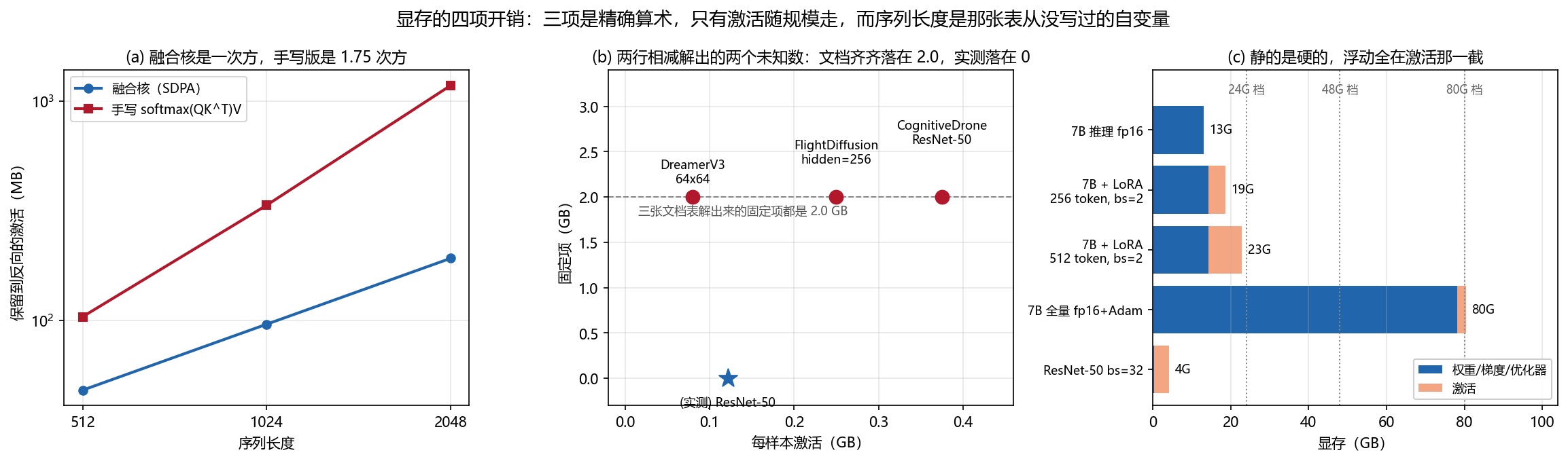
假设有这么一张三行的显存表。第 1 行和第 3 行只差 batch(50 → 100):6 GB 和 10 GB。两行相减解出每样本 0.08 GB、固定项 2.00 GB。第 2 行没有改 batch,只把分辨率从 64 提到 128 —— 按上面这个式子,它应该是 2.00 + 50 × 0.08 = 6.00 GB,可表里写的是 10 GB。多出来的 4 GB 就是分辨率那一项,也是这张表唯一没被算进去的变量。
DreamerV3 的世界模型不大(配置里 batch_size: 50、sequence_length: 64,输入才 64x64),正好可以把这笔账真算一遍。
建一个同规模的世界模型,量它的激活¶
import torch, torch.nn as nn
GB = 2 ** 30
def activation_bytes(m, x):        # 只数激活;参数按 storage 指针剔掉
    ps = {p.untyped_storage().data_ptr() for p in m.parameters()}
    tot = [0]
    def pack(t):
        if t.untyped_storage().data_ptr() not in ps:
            tot[0] += t.numel() * t.element_size()
        return t
    with torch.autograd.graph.saved_tensors_hooks(pack, lambda t: t):
        m(x).sum()
    return tot[0] / GB
class WorldModel(nn.Module):       # 缩小的 DreamerV3:卷积编码器 + GRU 序列模型 + 解码器
    def __init__(self, h=512, z=32, ch=48):
        super().__init__()
        self.z = z
        f = 4 * ch * 64                                 # 池到 8x8 再展平:参数量不随分辨率变
        self.enc = nn.Sequential(
            nn.Conv2d(3, ch, 4, 2, 1), nn.ReLU(), nn.Conv2d(ch, 2 * ch, 4, 2, 1), nn.ReLU(),
            nn.Conv2d(2 * ch, 4 * ch, 4, 2, 1), nn.ReLU(), nn.AdaptiveAvgPool2d(8),
            nn.Flatten(), nn.Linear(f, h))
        self.core = nn.GRUCell(h + z, h)
        self.post = nn.Linear(h, 2 * z)
        self.dec = nn.Linear(h + z, f)
    def forward(self, obs):                             # obs: (B, T, 3, res, res)
        h = torch.zeros(obs.shape[0], self.core.hidden_size)
        z = torch.zeros(obs.shape[0], self.z)
        outs = []
        for t in range(obs.shape[1]):                   # 序列模型逐步展开,激活按 T 累加
            h = self.core(torch.cat([self.enc(obs[:, t]), z], -1), h)
            mu, logvar = self.post(h).chunk(2, -1)
            z = mu + torch.randn_like(mu) * (0.5 * logvar).exp()
            outs.append(self.dec(torch.cat([h, z], -1)))
        return torch.stack(outs, 1)
torch.manual_seed(0)
for res in (64, 128):
    wm = WorldModel()
    n = sum(p.numel() for p in wm.parameters())
    a = activation_bytes(wm, torch.randn(50, 64, 3, res, res, requires_grad=True))
    print(f"{res}x{res}  batch=50 x 64 步  参数 {n/1e6:>5.1f}M  静态 {12*n/GB:>4.2f}G  "
          f"激活 {a:>6.2f}G  合计 {12*n/GB + a:>6.2f}G")
本地实测结果¶
64x64  batch=50 x 64 步  参数  15.0M  静态 0.17G  激活   2.41G  合计   2.58G
128x128  batch=50 x 64 步  参数  15.0M  静态 0.17G  激活   9.00G  合计   9.17G
第一,分辨率才是这个模型显存的杠杆。 像素数翻 4 倍(64² → 128²),激活从 2.41 GB 涨到 9.00 GB,3.7 倍 —— 卷积和逐像素解码的激活都正比于像素数。表里第 1 行到第 2 行写的却是 6 → 10 GB,只有 1.67 倍。实测的 9.17 GB 和第 2 行那个 10 GB 很接近(差 9%),对不上的是第 1 行:实测 2.58 GB,表里 6 GB,大了 2.3 倍。
第二,那个固定的 2.00 GB,比整个静态账大十几倍。 15.0M 参数的模型,权重加梯度加 Adam 一共 0.17 GB —— 也就是说 6 GB 那一行里只有 2.8% 是模型本身。反解出来的 2.00 GB 固定项占 33%。这一项不是模型,是框架和显存碎片;而这个数在 07/03(ResNet-50 表)、07/04(FlightDiffusion 表)里解出来也是 2.00。三个不同项目、三种不同模型,解出同一个两位有效数字的整数——这更像是估表时的同一个习惯,而不是三次独立测量。
第三,这个模型的激活是三个因子相乘,没有藏起来的自变量。 batch、sequence_length、像素数——三个都在配置里写着。batch 是线性的(第 1、3 两行解出的每样本项一致),序列长度是真循环展开(sequence_length: 64 直接把激活乘 64 倍),像素数是 3.7 倍对 4 倍。所以这张表要外推到别的配置,只需要这三个数;不像 7B 那几张表,还得先补一个没人写出来的序列长度。
限制:这里的
WorldModel是按本文 6.x 的结构缩比搭的(h=512、z=32、ch=48、三次步长 2 卷积),不是原版 DreamerV3 的实现,参数量 15.0M 也和原论文各个 size 档不一致。量的是 PyTorch eager 模式保留到反向的激活,不含框架开销、cuDNN workspace 与显存碎片;GRU 逐步展开的循环是真循环,所以sequence_length是线性乘在激活上的。反解出的 2.00 GB 固定项只有在两行确实是同一模型、同一输入分辨率时才成立。第 2 行改了分辨率,所以它和第 1 行之间不能做这个减法。
运行完整脚本¶
参考资源¶
- Dream to Fly 论文: https://arxiv.org/abs/2501.14377
- DreamerV3 论文: https://arxiv.org/abs/2301.04104
- DreamerV3 JAX 实现(论文未用): https://github.com/danijar/dreamerv3
- DreamerV3 PyTorch 实现(论文用的底座): https://github.com/NM512/dreamerv3-torch
- 同作者的新 PyTorch 版: https://github.com/NM512/r2dreamer
- Flightmare(动力学与赛道生成): https://github.com/uzh-rpg/flightmare
- Agilicious(平台与物理参数): https://github.com/uzh-rpg/agilicious
延伸阅读¶
- 什么是世界模型 — 理解世界模型的核心概念
- 模型强化学习世界模型 — Dreamer 系列详解
- 无人机世界模型综述 — 无人机世界模型全景
思考题¶
-
范式判断:在无人机竞速这个任务上,论文给出的世界模型路线的优势与代价分别是什么?这些说法各自踩在哪一条证据上?
-
复现风险:指南开头那段加粗提示说明复现的哪个前提不成立?它会改变你动手的第一步吗?
-
排障顺序:Actor 在想象里表现不错,一上真实(或仿真)环境就失效,文档给了哪几条改法?
-
算力取舍:手上一张 10 GB 左右的卡,训练时该先定分辨率还是先定 batch?依据是什么?
-
指标设计:论文用什么结果说明 DreamerV3 比 PPO/SAC 强?只看其中一个够不够?