UAV World Model & VLA & VLM Learning









What this is • What is different • Quick start • Contents • Cite • Contributing
The documentation is written in Chinese. This file and
docs/en/index.mdare the English front door: they map the repository and link to the Chinese originals. The 59 documents themselves are not translated.
What this is
59 documents · 195 papers · 24 CPU-only demos · ~287k Chinese characters.
World models, VLAs and VLMs are the three foundations of embodied AI right now. This repository turns them into a path you can walk from the beginning: the spine is general method and literature, and aerial robotics is a running thread through all nine sections rather than a side chapter.
Choosing drones as the specialisation narrows nothing — flight is the harshest embodiment there is (4-DoF control, a crash you cannot undo, an onboard compute budget measured in watts). Where a general method breaks in the air is exactly where its limits become visible.
Main references:
- arXiv:2605.00080 — World Model for Robot Learning: A Comprehensive Survey (43 pages, 2026).
- NTUMARS/Awesome-World-Model-for-Robotics-Policy
— a collection of world-model papers for robot policy learning; our annotations are in
references/awesome-annotations.md.
The three core concepts:
VLM (vision-language model)   VLA (vision-language-action)   World Model
"describe what it sees"       "describe, then act"           "predict what comes next"
┌─────────────┐               ┌─────────────┐                ┌─────────────┐
│  image+text │               │ img+text+act│                │ state + act │
│      ↓      │               │      ↓      │                │      ↓      │
│  understand │               │ understand  │                │ predict next│
└─────────────┘               └─────────────┘                └─────────────┘
 "obstacle ahead"            "turn left to avoid"           "what if I turn left"
What is different
Paper lists are not scarce. This repository tries to add three things they usually lack: you can run it, track it, and test yourself on it.
| Asset | What it is |
|---|---|
| 24 CPU-only demos | No training, no VRAM, each produces a figure in about two minutes. Every demo verifies exactly one claim in the text — and where a claim cannot be measured, the text says so instead of implying otherwise. See code/. |
| Frontier logs for all three topics | tools/watch.py re-queries world models / VLA / VLM monthly, producing references/*-watch-2026-10.md. |
| Self-assessment sets | docs/09-专题自测与考察/ — questions only; the body text gives pointers, never answers. |
| A hardware limit stated up front | Every number comes from a real run. The ceiling is a single 8 GB GPU, so this repository does not train large models — it covers what actually runs. |
A claim in the text looks like this — every figure below comes from a rerunnable script under
code/:
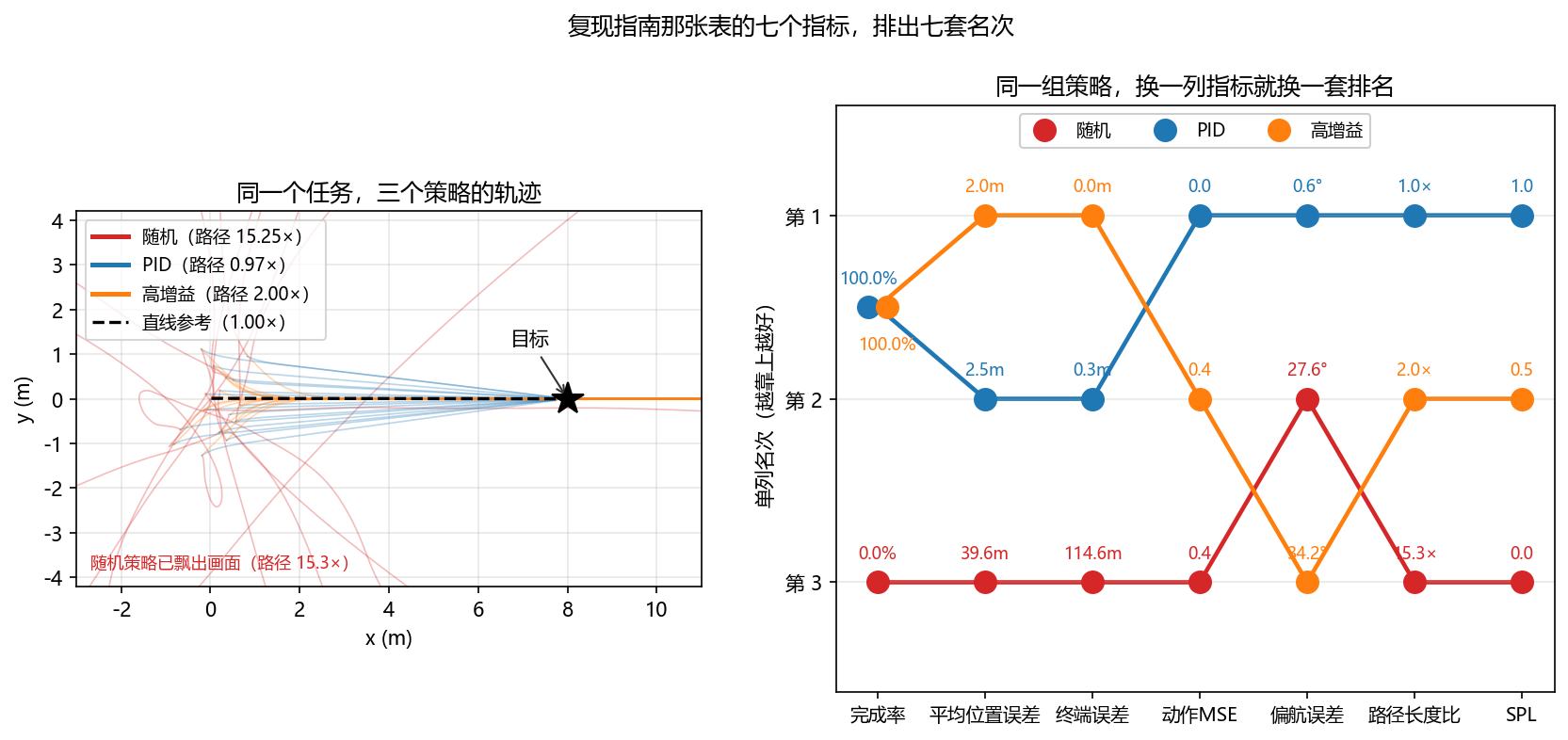 Seven navigation metrics, seven different rankings |
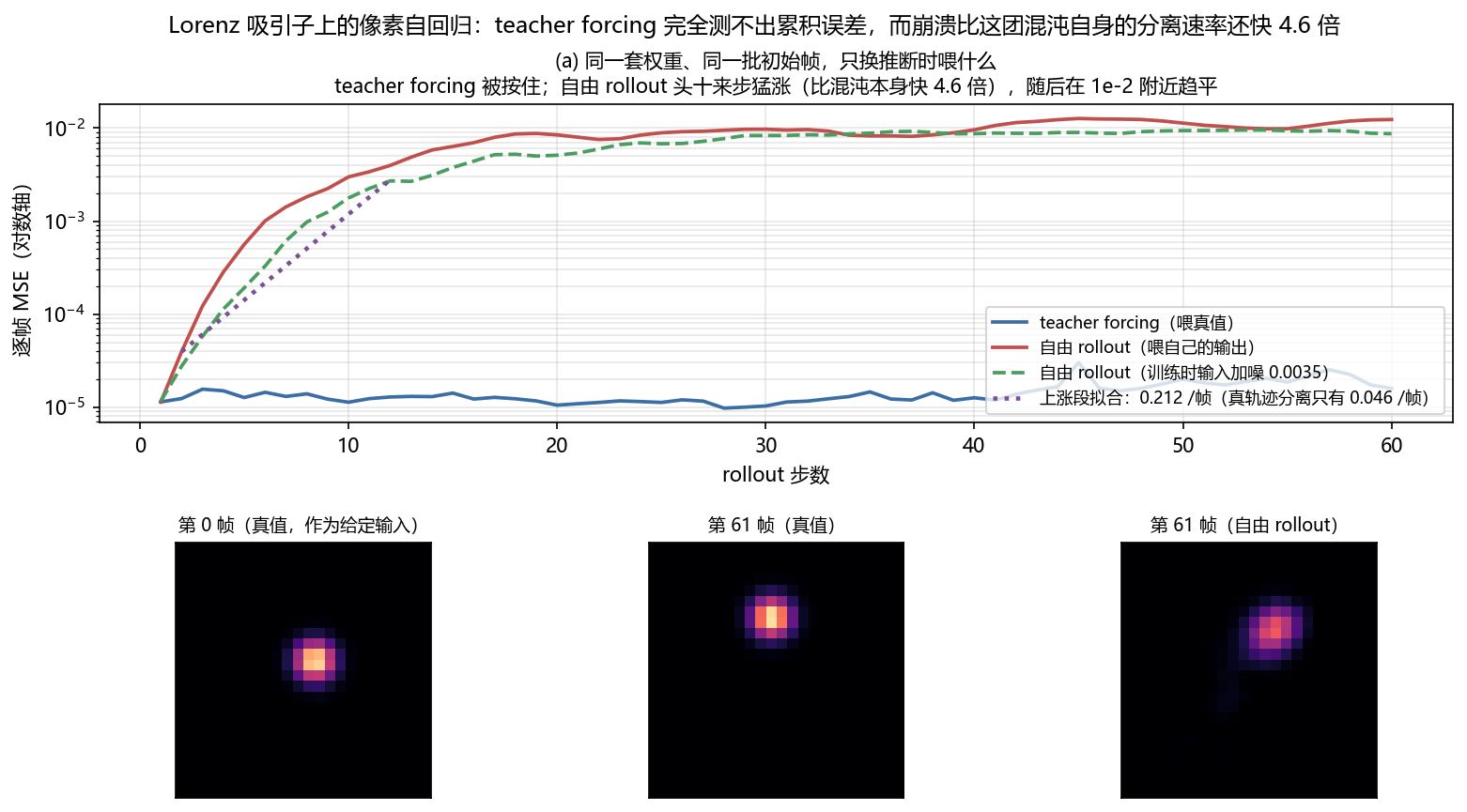 Feed the model its own output: step 60 is 1084× the error of step 1 |
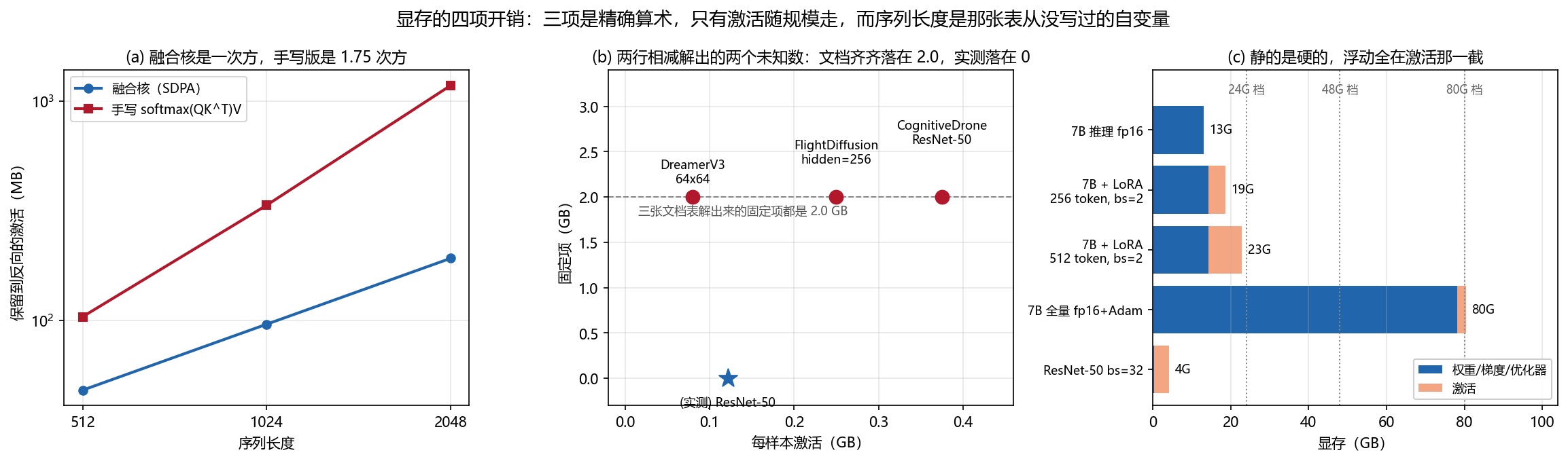 VRAM budget: three exact calculations, one measurement |
Quick start
git clone https://github.com/Qxy661/UAV-WM-VLA-Learning.git
cd UAV-WM-VLA-Learning
py -3.9 code/a_worldmodel_rssm.py     # CPU only, figure lands in figures/ in seconds
On Windows use py -3.9; on macOS / Linux use python3. All 24 demos need only numpy and
matplotlib — no GPU, no downloads, no model weights.
If you would rather only read: start with the study route (Chinese) or the English documentation overview.
Read it online: https://qxy661.github.io/UAV-WM-VLA-Learning/ — full-text search with
Chinese word segmentation, light/dark themes, rendered diagrams. GitHub Pages can be slow to
reach from mainland China; if it does not load, clone the repository and serve it locally:
pip install "mkdocs-material==9.7.*" "mkdocs<2" jieba, then
py -3.9 tools/build_docs.py && mkdocs serve.
Contents
Nine sections, 59 documents. The Chinese title of each section is the directory name.
| # | Section | Docs | Start |
|---|---|---|---|
| 00 | Study route and prerequisites | 1 | 导读与学习路线 |
| 01 | Foundations — what a world model / VLM / VLA is | 5 | 什么是世界模型 |
| 02 | World models — history, generative, model-based RL, 3D, long-horizon | 9 | 世界模型发展史 |
| 03 | VLA — architecture, aerial models, action heads, data, RL post-training | 10 | VLA 架构演进 |
| 04 | VLMs — remote sensing, aerial agents, edge deployment, evaluation | 7 | 遥感 VLM |
| 05 | Close reading of one survey, section by section | 5 | 综述概览与结构 |
| 06 | Paper cards — 45 papers, one card each | 4 | 世界模型论文卡片 |
| 07 | Hands-on guides — environment, 10 reproduction guides | 11 | 环境搭建 |
| 08 | Research frontier — roadmap, open problems, critical reading | 4 | 研究路线图 |
| 09 | Self-assessment — VLA / world model / VLM | 3 | VLA 专题自测 |
Also in the repository:
references/paper-list.md— all 195 papers with a ★★★ / ★★☆ / ★☆☆ recommendation scale.mindmaps/— 4 mind maps (field overview, world-model taxonomy, VLA timeline, reading order).code/— the 24 demos.tools/— frontier watching, link and nav linting.
Cite
CITATION.cff is in the repository root, so GitHub renders a Cite this
repository button with BibTeX and APA exports:
@software{qxy661_uav_wm_vla_2026,
  author  = {Qxy661},
  title   = {UAV World Model \& VLA \& VLM Learning},
  year    = {2026},
  version = {1.0.0},
  url     = {https://github.com/Qxy661/UAV-WM-VLA-Learning},
  license = {MIT}
}
Contributing
The contribution guide is in Chinese: CONTRIBUTING.md. In short — open an
issue with the file and line number, or send a PR that passes tools/check_links.py and
tools/check_nav.py. Issues are welcome in Chinese or English.
License
MIT.